Pages

Monday, October 10, 2011

Getting off the Ride

The roller coaster ride has continued since my last post.  On Lar's good days, I can almost convince myself that I can find a work around his condition and somehow make him a show horse despite the phantoms that plague him.  On his bad days, I just cry and feel my own spirit crumple a little more.  I know it's not his fault, but it still sucks.  It's time for me to get off this endless loop of rising and falling hope, of not knowing when or why he's going  to have fits.

Larry has a price tag on his head now, though it isn't much - just a few hundred dollars.  He's listed on the internet and I've been hauling him to every little saddle club show I can find (exploring some very rural and remote areas of the state to get there, I might add) armed with a stack of flyers and a smile forced on my face.  Even glossing over and downplaying his condition, there has been only a little interest quiet trail horse with "minor" issues, particularly issues like his. 

I have little doubt that I could give him away easily - to some scumbag who would put him in the next auction to turn a profit on a pretty horse's misfortune.  From there, he would change hands quickly and often, falling into increasingly desperate living conditions as his chain of owners discovered that he wasn't right.  I narrowly avoided this with the palomino horse of my dreams I bought from a horse trader a few years back.  And I won't go through it again.  (The abbreviated version: I bought a yearling from a shady horse trader, and as he grew a hip condition manifested itself.  Despite extensive medical care and a year of stall rest, the horse couldn't hold up to more than occasional light work.  When I tried to give him away as a pasture pet/light trail riding horse, the best offer I got was from a lady who told me everything I wanted to hear, including that she ran a horse rescue.  I arrived at a shabby single-wide in the middle of nowhere surrounded by ramshackle fencing on a steep 3 acre mud cliff.  Her "rescue" had just her personal mare, who was in foal.  I left him there despite my better instincts, crying the entire drive home for betraying a horse who had done nothing but trust me.  In short order, I discovered that she solicited free horses and quickly turned them for a small profit.  I managed to get him back through a clause in the contract I made her sign, but it was a close call.  I eventually found him a good home as a companion and trail horse, but it wasn't easy and I don't expect to get that lucky again.)  And I won't go through it again. 

What continues to amaze me about Larry is his willingness to stay cheerful and keep trying despite his pervasive (and by all accounts painful) problem.  You'd think after years of living with discomfort that he'd become surly and withdrawn.  I have no doubt that without the condition, he'd make a very nice horse for any rider or discipline.  I also don't blame his last owner for the condition. HSS is not especially common and many horsepeople simply haven't heard of it.  I knew something was off about Larry, but it took me several months to pinpoint what was behind his problems, and the horse came from a non-riding home.  Under those circumstances, it's easy to attribute an occasional fit to simple stubbornness and to call his behavior in the stall a quirk.

I've ridden this ride as far as I can bear it, though, and it's time to get off.  What kind of life is there for a headshaking horse whose biggest attributes are his beauty and tolerance?  I'm down to my last few options. If I can't find him a trail riding home, I may try to have him placed through a horse rescue as a pasture/companion horse where he can live out his days eating and hanging out with a buddy (good work if you can get it!) or donate him to the university as a research horse where he could be used to teach conformation to the students and participate in nutrition trials.  (I grant that the term "research horse" sounds scary, but having worked with them, I can assure you that they spend most of their days living the life of Riley and doing little else but loafing in the pasture interspersed by the occasional experimental diet and blood test.)  I hope that these options work for him, though in this economy I'm sure there's no shortage of horses being offered up on either front.  It's heart-wrenching to give him up, but it's even more heart-wrenching to keep him.  I cannot continue to ride this roller-coaster of hope and despondency, hoping for a magic wand and being crushed because it's just a common ordinary stick.  It's been a long ride in a short time, but it's time for me to get off now.  It's time for Lar to write the next chapter with a new owner and a job that he can do.


Video of his rotary headshaking and mouthing behavior in the stall.  Some days he does this nearly constantly when in the stall, other days not at all:

http://www.youtube.com/watch?v=xNaApPBzjfI

Thursday, September 22, 2011

Chasing Pavements

I have been mulling over the writing of this blog post for a while now.  As I turned on the radio and sat down to start writing, the Adele song, "Chasing Pavements" came on.  The lyrics are quite fitting to the the questions circling me right now.  "Should I give up, or should I just keep chasing pavements?"

I am facing some tough decisions on several fronts.  I know I am fortunate - I have a supportive husband who allows me to reach for my dreams.  I have roof over my head, food on my plate every night.  I have cars to drive, horses to ride, and pets to love. I have some tough decisions ahead of me, and it is better than facing a difficult future without the ability to make those decisions, but they are still tough. 

A sweet tabby face and chirpy meow greets me whenever I open my basement door.  Bob, the one-time barn cat who adopted me last fall, always has a cheerful greeting for visitors familiar and unfamiliar despite the FIV that has torn down his immune system and allowed giardia to ravage his innards.  Treatment only eases his symptoms briefly, before the raging diarrhea resumes.  We have exhausted his treatment options.  He is incontinent and I am constantly cleaning up his accidents throughout my basement.  It's a disgusting and constant mess, but I can't be too unhappy about it when he still so cheerful, chirping and purring as he bounds to meet me, though his digestive tract must give him constant suffering.  I know that I'm going to have to make that decision pretty soon, though.  His condition is terminal, and it will fully overcome his body and his cheery outlook.  Though he keeps chasing pavements (and my ankles), I will have to give up for him.  All I can do is make his last weeks on earth happy ones, but I hate knowing that his life will have to end at my hands. 

Larry and I have been chasing pavements of our own.  He is a beautiful horse, well-built, sensible in new surroundings, calm but curious, and full of personality.  He is so close to being just what I wanted in another show horse.  But I guess there's always a catch. For Larry, it is his headshaking syndrome - the neural condition that causes him to involuntarily jerk and twitch his head.  I've researched the condition, delved into his past, and analyzed his present.  I've tried nose nets, fly masks, every bit and non-bit in my tack trunk, different (and no) tack, different riding and training tactics.  I've ridden in near darkness and in blazing sunlight.  I've dosed him with melatonin and dexamethasone.  I've cried, yelled, whispered, and begged.  I can reduce his episodes via the nose net, fly mask, and/or melatonin but cannot eliminate them.  Weaning him off of the melatonin and onto the dex made me realize that the melatonin did more for him than I initially thought, but the dex did nothing.  Somehow, his great Standardbred nature has shown through the HSS complications and he's progressed under saddle - he now backs readily with the softest of bit pressure, moves off leg and seat pressure, bends around his corners, yields his hindquarters and forehand on command, drags a rattling jug of nails off his back, and pushes boldly through a curtain of water noodles, but he'll never be able to hold a consistent frame or go like a show pleasure horse with his involuntary head flip. 

I want so much for him to be my perfect show horse, but I think the time has come to realize his path and mine are not compatible.  I want to dabble in lots of disciplines - jump, do dressage, ride bareback, go western, and push the horizons of the Standardbred in the show ring.  With appropriate management, he is certainly rideable and capable of pleasure riding and the occasional fun show (where the equipment he wears and how he holds his head aren't so critical), but I think the type and amount of showing that I want to do isn't fair to him.  I can't show with a fly mask, using the nose net is contentious beyond all but the lowest levels of pleasure shows and is prohibited outright in dressage competition.  Even if there had been a pharmaceutical answer, I still would have misgivings about the consequences of medicating him forever.  I don't think I'll ever feel comfortable jumping him when an ill-timed head flip could have dangerous consequences for us both. 

I now face the reluctant task of finding him a home that meets his needs.  I had hoped to do several more shows with him this season, optimistic that I would have found a way to make us work.  I will finish out the show season as best I can; there are several smaller saddle club shows where there may just be a saddle club member looking for a beautiful horse to trail ride and do a few small shows with.  Somewhere out there is just the right home for him, and I hope, somewhere out there, is just the right new Standardbred for me.  We start these blogs hoping they will become the chronicles for future greatness - stories of a journey to the summit of some great peak.  I guess this one is just the tale of chasing pavement that didn't lead where I hoped it would. 

Thursday, September 8, 2011

Back to the Lab, Watson.

Lar had his date with the vet this morning.  I am thrilled that my favorite vet chose to return to KY after spending much of this year at a practice in Colorado, and happier still that he's had some success with headshaking cases previously.  He confirmed my observations and Lar's video clips as headshaking. syndrome.  General physical examination and ocular and facial examination didn't reveal anything significant, though while taking heart rate, Lar's heart rate shot up rapidly from 40 to 65 bpm before easing back to 40 bpm.  (Possible link to his training anxiety?)  The modern age of computers, video, etc. sure makes things a lot easier, as this entire week has been too dreary, cold, and rainy to ride or put Lar on the lunge line.  In Lar's case, the vet thought allergies seemed like the most likely trigger.  He's had luck with twice daily cyproheptadine, an anti-serotinergic and anti-cholinergic allergy medication.  I asked about testing for specific allergens, but he thought it would be very difficult to isolate a specific trigger allergen (not to mention then trying to eliminate it from the environment if it's something common like grass or tree pollen!).

Scientific Content Alert - avoid the next two paragraphs if you're not interested in the underlying science!  Serotonin acts as a neurotransmitter in the body.  It is linked with feelings of happiness and well-being; many antidepressants are targetted towards promoting it, and some illegal drugs act by making its levels spike in the body.  It also participates in the process of blood clotting.  It causes vasoconstriction, and quantities of it in the body can pain sensations (for example, wasps and some snakes inject it into their prey when they sting or bite).  Acetylcholine is a generally excitatory neurotransmitter in the body that acts presynaptically in the sympathetic nervous system and pre and post synaptically in the parasympathetic nervous system.  (It's pretty convenient that I've concurrently been studying some of these topics in my anatomy and physiology class.)  It seems logical that cypro could be effective in some headshakers by reducing symptoms associated with allergic response and/or excesses of these neurotransmitters.

The downsides are that it generally requires twice daily administration (in less severe cases, it may be reduced to once daily administration) at a cost of a few dollars a day.  It is also prohibited by most horse show sanctioning bodies, so horses must be taken off of it several days prior to competing (meaning that their symptoms may start to return just when you really need them to be on their best behavior).  Its efficacy can be hit or miss in headshakers, but my vet has had a personal success with it rate higher than the average, perhaps because KY is such an allergen riddled region.  Another treatment option is pulse dosing with dexamethasone, a steroidal antiinflammatory and immunosuppressant agent.  Allergies are basically the overreaction of the immune system to benign agents, so that coupled with mediation of inflammatory response explains the probable course of action in headshakers.  With long-term administration, immunosuppression, weight gain, and GI upset can be a problem.  The accepted course of treatment with the dex pulse therapy is to administer a fairly high dose for three consecutive days, then repeat every three to four weeks.  This relieves most of the risks associated with long term administration and (with proper planning) doesn't require mandatory cessation of treatment prior to sanctioned competitions.

So the current plan is to discontinue the melatonin (which didn't seem to do anything for him) and try the dexamethasone as both a diagnostic tool and treatment.  If it works, there's a decent chance that the cypro will also work if I need to alternate or change medications.

 I still wonder about headshaking being the root cause of all of his issues, as he does have some ability to suppress (but not eliminate) his behaviors when you really get after him (as I had to last week after he nearly pitched me while having a particularly bad episode).  I have no doubt the physical component is real.  The better questions are (1) can it be suppressed? (hence all of the neural experiments and pharmacology) and (2) can he be happy and comfortable doing what I want him to do?  Ultimately, the answer may be a combination of physical and behavioral, and it's quite possible that the life of showing I want to pursue with him may not be the best route for him.  

Better living through pharmacology?  I hope the answer lies at the bottom of the dose syringe. but only time (and more experimentation) will tell...

Friday, August 19, 2011

Mindless Ramblings

As I write this, I should be on my way to New Jersey for the National Standardbred Horse Show, primed to see all my friends and add more accolades to my wonderful old mare's collection.  Or at least at the local show about an hour down the parkway, getting more mileage and experience for my would be show prospect.  Instead, I am at home in a quiet house, letting my mind wander over roads both traveled and untraveled.

I am continuing to read journal articles and trying to solve the complex HSS puzzle, namely what triggers Larry's fits.  I'm trying to keep up the motivation to continue riding and working with him, but it's hard to persevere when I feel like it only serves to frustrate the both of us.  Riding has become a series of neural experiments instead of a pleasurable activity and showing seems like a fruitless endeavor for us both.  My latest experiment focused on revisiting bitting and the effects of the fly mask.  I tried him in the curved sweet iron bit that he seemed to accept the best, sans mask or nose net.  Mild headshaking showed up after a few warm up laps at the walk on a loose rein.  I fitted his fly mask over the bridle.  This mask is his daily one, made of fine mesh, as opposed to the more traditional coarse mesh mask that hadn't yielded any difference when I lunged him in it.  With the fine mesh mask, he was more rideable than without it, though certainly not "cured."  The previous day, I had ridden him in the fine mesh mask in combination with his nose net and he was again relatively rideable. 

I pondered what these additional findings meant, and it was actually J who helped me make the association - wind.  Air movement across the face and in the nostrils seems to be Larry's primary trigger.  He isn't photic from what I can tell - the coarse mask didn't help, and his attacks don't seem to change day or night.  But the fine mask did help some, and it would block more wind than the coarse mask.  Likewise, the organdy nose net helps some, and it blocks some breeze on and in the nose.  The attacks get worse the harder he works, and especially about cantering, and working at speed produces more wind movement across the face and through the netting.  This would also explain some of the inconsistencies I saw when I first started using the nose net - I wasn't exactly tracking or monitoring wind speed, why he would have fits in certain arenas or areas without an obvious pattern, and why the tulle nose nets were less effective than the organdy ones.  Franklin County, where he was like a different horse, has an arena that is bunkered by earth tiers on all sides.  Coupled with his nose net, that would make for minimal breezes across his face.  Grant County, where he was also nearly symptom-free, was a very hot and muggy day - the type where the wind is still and thick.  The first time at Henry County, the outdoor warmup area likely had more breezes than the covered arena where he was better,  The second time at Henry County, with his nose net, he was better in the earlier hunt seat classes, but terrible in his later western class after a strong and windy storm system had rolled through.  This may also explain the day on the lunge line early in the Spring when he bucked repeatedly and bolted, a season that is notorious for wind.

Looking back, when I first got him in the fall/winter I thought he was bothered by his mane and forelock tickling his ears and face, so I started braiding it out of the way.  Now I realize that was his HSS coming out.  I was able to get some more information from one of his previous riders.  It turns out that he has had the same head tic and foot flipping symptoms for years, and his behavior on the track seems indicative of HSS, too.  She, like my initial assessment, thought he was just being stubborn and temperamental.  Because she only rode him periodically, she was unable to determine if there was seasonality to his symptoms.  She did indicate that he used to canter readily under saddle, but became less willing and more rebellious about it over time.  I worry that his condition will worsen over time.  I worry that at the end of it, I'll still have a horse plagued by phantoms and unable to cope with the demands of regular riding and showing.  I worry that what should be fun will only be torture for us both.  I worry that I am chasing answers more elusive than the wind that seems to set him off.


I started him on melatonin this week.  It may help seasonally affected headshakers, as it essentially fools the body into thinking that it is winter (thus stopping the surge of GnRH that prompts estrous in mares and sperm production in stallions.  Geldings lack the testosterone or estrogen surge that shuts the GnRH off, and GnRH's vasodilating effects is one possible theory for idiopathic headshaking)  It also offers some possible neuroprotective properties.  I'm not optimistic that it will work, as I have a feeling that he's untimately afflicted year-round, but it's one more thing to test and confirm or rule out.  Ultimately, I'm not sure how much I want to put him or myself through, chasing down what may be a winless battle.  Only time will tell, I suppose.  I've been seeking another show horse since 2005 or so, and I'm starting to feel like it's simply not meant to be.  I know Legs is one in a million and I'll never find her equal, but sound, sane, and trainable would be a nice start.

So here I sit, typing and rambling, sore from an evening spent pulling weeds in the fields, yet sadly with more satisfaction from that chore than riding, showing, or racing have brought me in many months.  I'm throwing myself a pity party tonight, admission for one human and a sad and motley assortment of down and out animals - Legs with her fragile feet but enduring heart, Larry with his beautiful face and involuntary head tic, Josie the flea allergic dog who can't stop scratching herself, Junior the herpes infected kitten who's amazingly still alive 13 months after I found him and thought him marked for death, Bob the FIV positive stray who's now living in (and making a mess of) my basement, Maya the 13 year old curmudgeon who can no longer thrive as a barn cat and now lives in the guest room.  Please, no more broken animals; I just can't do it anymore.


Monday, August 15, 2011

Puzzling Pieces

In my last post, I reported making the discovery that Larry has multiple symptoms of headshaking syndrome (HSS).  Ever since, I have been trying to assemble the pieces of his symptoms and his triggers so that I can figure out how to deal with this condition.  So far it has felt like someone mixed several 1,000 piece puzzles together into one bin and told me to solve them without any guidance or even the picture on the box.

I have been looking at scientific journal articles trying to see what causes and treatments have been investigated (though a lot are pay sites, which is unfortunate).  I have looked at public websites and forums about the condition (taken with a grain of salt - some are useful, some seem to be complete bunk like the one endorsing a costly homeopathic remedy that blames the condition on vaccinations but doesn't go into the modality of HOW vaccines would cause the condition or how their homeopathic remedy cures it).  I did find this excellent website about headshaking put together by a British university.  It addresses multiple facets of the condition and has a basis in scientific study.  http://www.lincoln.ac.uk/dbs/research/headshaking/ 

So here are the puzzle pieces I've been trying to fit together.

BACKGROUND INFO:
Larry is an 8 year old Standardbred gelding.  He was on the racetrack until he was 5 or 6, but only ran a few qualifiers and made one start.  He was kicked in the jaw when younger, but unfortunately I don't have any details.  He does have a small bony bump under his jaw that feels like a retained cap but doesn't seem to cause him any problems.  He was apparently difficult to train at the track and may have had some training anxiety issues where he would get very tense about being harnessed.  He was shown extensively by his prior owner (his track groom) in halter and showmanship classes, but was seldom ridden as his prior owner doesn't ride.  He had some walk-trot riding work in jumping and western pleasure with a couple different riders during that time period, but it was sporadic.  He never progressed to canter work, though he did jump (from a trot).

I got him in October of his 7 year old year.  He is generally quite laid back, kind of lazy, and seldom spooky to work with.  He is relaxed on cross-ties and totally unfazed by being tacked up.  He handles new environments well.  I honestly can't tell how much of a willing learner he is, since it is hard to assess any progress when the horse is constantly distracted by flipping his head.  He spent a fair amount of time stabled when he lived in NJ, but is now pastured in central KY (the allergy capitol of the world).


SYMPTOMS:
Rotary Headshaking - Larry violently flings his head in circles when standing with his head over the stall door.  I originally attributed it to dental pain or a learned behavior he'd developed at the track from boredom or anticipation of feeding.  He has done this year round.  He continues to do it even after the dentist examined him and gave him a clean bill of health.

Horizontal Headshaking - Larry has a tendency to jerk or twitch his head upwards and to the side on the lunge line and while ridden (it is especially noticeable while ridden, particularly at the trot).  It is very much like a nervous tic and he will often get very tense with his head and neck and will move very short and stiltedly at the trot.  On worse days, he will fling his head up, especially when asked to go from walk to trot, moreso than the typical "Standardbred Shuffle" they often do in anticipation of moving the weight of the cart and driver forwards when first starting out.  He does this both on the lunge line and under saddle.  Now that I am more aware of it, I have started noticing his tic in hand, too, both at home and at shows.  It is more manageable then because we aren't moving fast or doing a lot in hand. 

Striking at Nose With Forelegs - In an earlier post, I described Larry's semi-rear.  He'll be walking or trotting (usually trotting) along on the lunge line or under saddle and suddenly toss his head and flip his forelegs out individually, often accompanied by a grunt.  At the time, I thought he was being unruly and that he was basically flipping me the bird.  After reading more about headshaking, I now realize this was his attempt to rub his nose with his forelegs while moving.  Because I thought he was acting out, I had been punishing him for this behavior.  While lunging, I would make him change directions and work harder when he did it.  I found it hard to reward him on the lunge line since I couldn't get more than 5 or 6 strides without some sort of fit, though the feet flipping did reduce quite a bit the more I lunged him and punished him for it.  I was working him pretty consistently at the time, trying to "work him out" of what I attributed to "his bad attitude."  Under saddle, I resorted to striking him with a crop on the shoulder and spinning him the other direction.  The behavior was quite erratic under saddle, so I never could tell if that had any effect on the behavior, though for a while between the lunging and riding punishment, it felt like he was trying to suppress the behaviors somewhat.

Excessive Rubbing of the Nose - I have noticed this also on the lunge line and under saddle.  There was one day several months ago that I was lunging him and he trotted over a lap with his nose dragging the ground and his front feet brushing his chin.  I checked him for back pain, thinking he was stretching, but found nothing.  He has done it at other times, but that was the most blatant episode.  Lately I have noticed that he will rub his nose on his forelegs (or sometimes objects) a lot after a brief period of riding.

Snorting/Blowing the Nose - I have been noticing this one ever since I discovered the link between his behaviors and headshaking syndrome.  He seems to do it more when wearing the nose nets I made for him (more on that later).

Flipping the Nose or Upper Lip - He has always been a mouthy/nosy horse - the type that gets into stuff, chews on the leadrope or sometimes the fence plank, and generally wants to get his nose into things and/or mooch for treats (which I have been trying to curb by feeding a lot less treats).  On cross-ties, sometimes he will chew/gnash his teeth or wiggle his lips.  I have seen many horses that have mouthy and lippy behaviors without displaying any other symptoms of HSS, though, so I wouldn't take this as a definitive sign by itself.  He also chews the bit a lot, and I spent a lot of time trying out different bits (and a sidepull and a bosal) to see what he went best in, as I thought he might have a low palate.  Naturally, I had the dentist out first, who gave him a thorough exam and floating and gave him a clean bill of health.  I have a prior blog post about that if you want to see more detail.

Rolling - This isn't listed as a symptom that I have seen, but it may or may not be related.  Larry rolls more than any other horse I've known.  He rolls multiple times a day in the field, possibly because he is itchy, though he doesn't respond to currying as dramatically as my other mare who has very distinct itchy spots.  Other than this, he doesn't seem to show any other symptoms in the pasture. 

OTHER SYMPTOMS:
 Protecting the head, eye discharge, clamping the nostrils, hair loss/facial swelling (from rubbing), general hypersensitivity of the head.  Larry doesn't really show any of these symptoms.  He does like to hang out in the run-in shed on hot sunny days, but that could easily be good sense rather than avoiding sunlight.

PATTERNS:
This has been the most difficult component to determine.  There seems to be a stress component to his fits, as he gets worse when I am trying to teach him something new or we are in a new and stressful environment.  Though he is generally calm to handle at shows, under saddle classes do seem to exacerbate his head shaking.  Training wise, I can never tell if he has figured out a new concept (such as turns on the forehand and haunches) because of his fits, but inexplicably, weeks later, he was suddenly able to pivot on command whereas he wouldn't before.

Along with stress, work seems to trigger it.  The headshaking usually appears most prominently during trot work, either lunging or riding.  The harder he is worked, the worse it gets.  Last week when trying to get a canter under saddle (which involves a lot of effort on his part as he figures out what to do with himself), he went from a decent riding day HSS wise to pretty bad.  With his apparent training anxiety at the racetrack, it seems likely that he's been an undiagnosed lifetime headshaker.  Certainly the discomfort from his attacks could make him fear and resent harnessing and the many subsequent training miles he was expected to go at the track.

A common trigger for many headshakers is light.  This is termed photic headshaking and strong sunlight can set them off.  I haven't been able to pinpoint if this plays into Larry's behavior.  I mostly ride in the evenings to avoid the summer heat, so the sun is setting, though there are some long shadows and areas of sun vs. shade where we ride.  In June, he had episodes in the outdoor warmup area at Henry Co., but was quite a bit better in the semi-dim covered arena.  At a mid-July evening show, he had some awful episodes in the dim warmup area as well as the unevenly lit outdoor arena (rearing/bucking for the first time under saddle).  Less a week later, with his new nose net, he was ok at the outdoor Oldham Co. show (early evening), nearly perfect at the Franklin Co. evening show the following night, and great but tired at the sunny Grant Co. daytime show two days later.  (Mind you, he is only going in 2 or 3 classes per show, nothing more strenuous than walk-trot, and this was an aberration as I don't ordinarily show him more than every other week, so I'm not working him to death here.)  But last week, back at the Henry Co. covered arena (with nose net on), he was ok in the hunter walk-trot (with snaffle) and awful in the western walk-trot (with bosal).  One evening in late July/early August, we tried to get some video of him being ridden with and without his nose net.  Without the nose net, he responded by rearing in the same two corners of the arena every time, which could be related to the play of shadows and sunlight in the evening, but it's hard to tell.  With the net, he still flipped his head, but no longer reared.  I lunged him with his fly mask to see if shielding the light would help, but it didn't appear to make a difference.  I plan to try again to give it a fair shake. 


I presume there's a seasonal component to his behavior, but since this is the first year I've had him and it started so insidiously, I really can't say when it started.  I don't ride much over the winter due to weather and footing, so that makes it harder to determine the onset.  Here in KY in July and August, his behaviors do seem to be getting worse.  I don't know yet if/when it will abate in the fall.  Seasonality could be related to sunlight triggered hormone levels (eg the pineal gland's response to lengthening sunlight, shedding the coat and ramping up estrous hormones in mares) and also to allergens.  KY is often called the allergy capitol of the world.  My older STB mare has had mild allergies for years since living here, but they are confined to a seasonal runny nose and itchy skin and I treat her with oral antihistamines when her symptoms get too bad.  Larry hasn't shown any of these types of signs (with the possible exception of his rolling in the dirt, mentioned above), but he has been snorting/sneezing more frequently lately.

RULING THINGS OUT:
I initially thought he had bitting problems, so I had him examined and floated by a very good equine dentist.  I tried a wide variety of bits on him, finally settling on a three piece loose ring snaffle of moderate thickness for hunt seat use.  For western, I used either a thinner curved sweet iron loose ring, a side pull, or a bosal.  His issues were no different in the bitless options as with a bit.  I was told by the girl who rode him western before that he didn't like curb straps or the chain under his jaw with his western halter.  I have been riding in a snaffle, but did test this twice; he didn't seem thrilled by the strap, but wasn't horrible.

I thought back pain or lameness could have been causing his discomfort, but palpation and examination haven't shown either one of these to be problems, and trying Bute didn't change anything.   I also put him on a course of ranitidine, thinking it was stress or ulcers but there was no difference.

Some people blame such behaviors solely on poor riding.  I consider myself a pretty accomplished amateur rider with numerous national titles in a variety of disciplines with my older STB mare.  In addition, Larry shows the behaviors on the lunge line (with no rider) just as much as under saddle.

I initially thought it was stubbornness.  As described above, I put him in a regular work regimen in which he was rewarded with praise and less work for good behavior and had to work harder and longer when he behaved badly.  I saw some improvement in the worst of the feet flipping with the lunging work, but the other behaviors continued both under saddle and on the lunge line.  I found it hard to find opportunities to reward the good behavior, as he could barely string together half of a 20 m circle without flipping his head.  It got to the point where I would say "good boy" and he would plow to a stop after just 5 fit-free trot strides because that was the most he could manage. 

TREATMENT:
It is normal for horses to occasionally bob their heads in response to flies or other stimuli.  However, Larry does this and far more with and without fly spray and in the presence and absence of flies.

I tried lunging him with his fly mask once to see if shading the light would help, but it didn't seem to.  I will try working him with it again to give it a fair shake.

Another non-invasive option was the nose net.  It looks like this: http://www.smartpakequine.com/equilibrium-net-relief-muzzle-net-6680p.aspx except that I made my own out of black organdy (a sheer but semi-stiff fabric used for prom dresses, etc.) tailored to his nose in styles to work with both my English and western bridles.  At first, I thought this was going to solve all of our problems.  The first three times he wore it, he was improved at Oldham Co., and the best he'd ever gone in his life at Franklin Co. and Grant Co.  For the first time ever, he was able to trot multiple laps of the arena without flipping his head.  Less than a month later, though, it is only bringing about some improvement.  We videotaped him with and without it one evening.  He reared and cramped himself up without it, and with it, the rearing was gone, but he still had head flipping and snorting episodes.  This past weekend, he was somewhat ok with it in his hunt seat classes, but truly awful with it and his bosal in the western class.  He has started to flip it askew on his nose, so last night I put a flash noseband over it to hold it in place (anticipating adding an elastic cord to secure it under the jaw if that worked), but there was no improvement.  I also tried hair nets and panty hose over his nose, but he tried to pull those into his mouth and eat them so I gave up on that idea.

I haven't tried him on allergy medicine yet, as I wanted to try the non-chemical routes first, but that is next on the list.  I have a jar of Hist-All that I will probably start him on today.

The other move at the top of my list is to see what other veterinary options are available.  I wanted to gather as much information on my own as I could to make the most of the vet's visit.  (That and my sick cat took over any available veterinary funds for the month).  I really hope that there is an effective surgical option available.  I would really rather physically stop the problem than have to constantly medicate him or have a would-be show horse that can't be ridden from April through October.

I honestly don't know what I'm going to do.  I got him to use as a riding and show horse.  He is a gorgeous horse and has the raw materials to be a good show horse, but we can't make any training progress if he's too bothered by his head to learn, and it seems foolish to keep hauling him to shows if I know he's going to have issues more often than not.  (Before I realized he had HSS, I was hoping that I could work him out of his anxieties/issues by taking him lots of places and doing a lot with him, but now I realize that it's a neurologic problem rather than behavioral in origin.)  He's pretty limited as a show horse if we can't trot in a straight line with our head pointed in (mostly) one direction.  I certainly hope there's a solution to this puzzle, but right now I just have a whole lot of pieces and no clear picture.
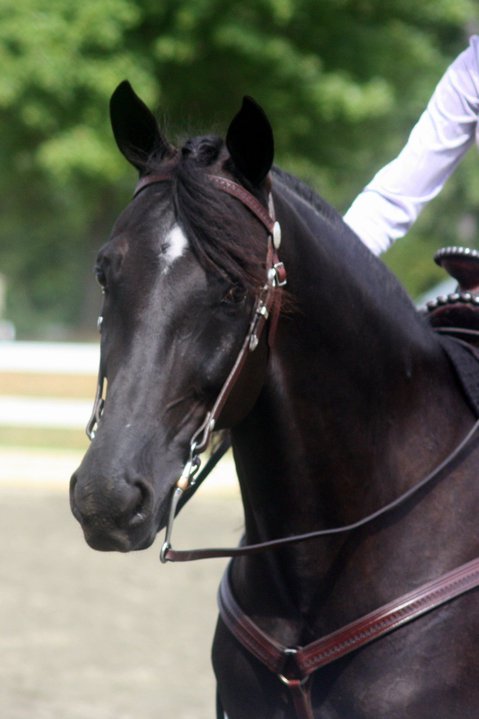


Saturday, July 23, 2011

Following Up

This has been a crazy week.  Two exams, 1 quiz, homework due, and I squeezed in three horse shows, and have autocross tomorrow, too.  Next week, 2 more exams and another quiz!  The pace of summer school is insane, but I still know I made the right choice versus staying where I was at.

My last blog chronicled the adventures of me and Lar at the Oldham and Franklin County Fairs.  I had planned to take Legs to the Grant County Western show in Saturday in a couple hunt seat classes and horsemanship.  But she was still a little sore following her last farrier visit and I decided it best to give her more time off.  She was trimmed a little shorter than I'd like, but her feet had broken up thanks to stomping at flies (despite her plastic shoes and the daily applications of fly spray the ponies receive) so there wasn't much alternative.  Contrary to most navicular horses, she's soundest late into the shoeing cycle and most likely to be sore following being reset.  The show had just a few classes that Lar could go in, two in hand and 1 riding, so I thought it wouldn't be too taxing to take him instead.

In hindsight I wish I'd skipped out.  He was a good sport, but pretty pooped after the previous two shows this week.  When I loaded him up to go home, he just stood at the doorway of the trailer with a "this is the last time for a while, right?" pleading sort of look before I finally coaxed him on.  In showmanship, he didn't even want to trot with me, which isn't like him, and I had to use lots of leg to keep him trotting in our pleasure class.  I don't think it would have mattered much anyway, since we were a bit out of our element and out of our league at a largely AQHA crowd type of show.  The show management decided to allow cross-entering between the WT and WTC classes which they usually don't do at this show, which meant that my WT class was full of trainers on finished horses just looking to cash in on the payback money being offered.  We were the only hunter horse amidst a crowd of fancy western pleasure horses.  Nope, not gonna be our day.

Placings wise, the show was a total flop.  But it did give me some valuable info.  I've concluded that 3 shows in 4 days is too many!  I'm sure 2 of them being night shows with carnivals was especially tiring for him.  It was my first time using his tail extension.  Everyone else at the show had one, so when in Rome...  The first time I put it in, it didn't look so great; the second time was better, but I'll probably reserve it for more important shows since it was hard not to rip hair out when removing it.  I learned that I can do a running braid in just over the time it takes to hold one flat class.  I also concluded that Lar looks/does better in hand when presented as a hunter horse.  He looks beautiful in his silver show halter, but compared to the real QH, he just doesn't have that heavy muscled stock horse look.  Riding wise, the old Lar would have had fits about being ridden when tired.  New Lar with nose net trucked on faithfully - he just needed a lot more leg.  But he stayed soft, focused, and on the bit.  This is HUGE progress over how we were going just a week ago.  He has forgotten how to back under saddle this week, so we'll do some refresher work on that - after he's had a few days of R&R to recover from all the showing.  I'm looking forward to all of the new progress we can make now that I have a more willing and relaxed partner!

On a side note, I have had four friends lose their horses unexpectedly during the past year (colic, laminitis, EPM complications).  It's a sobering reminder to the rest of us to hug our equine friends often and appreciate them for their individuality and all that they give to us while asking so little in return.

Thursday, July 21, 2011

Eureka!

Larry's training has continued in much the same fashion as I've reported previously.  Small increments of progress, but still a fair amount of frustration.  He'll show me glimmers of the good Larry but punctuated still by the horse that refuses to bend, wants to stop every 5 strides, and flips his head in the air or gets tense and wadded up.  To stave off the drudgery of walking and trotting in circles every day, I proceeded to try some western with him.  He's not half bad even as green as he is, and I can tell that he has the potential to be even better.  I think he will have an easier time with the jog than Legs, who worked very hard for years to overcome her long-backed conformation and shorten her long hunter stride into a mincing jog.  (Legs' lope, OTOH, can't be touched by most QH  >:D )  I've been working him in a bosal since he's fussy mouthed and it also makes a clear distinction between his hunt bridle and his western bridle to help him figure out how to travel.  It works out pretty well, though sometimes he takes advantage of the lack of bit, ignores steering inputs and meanders about like a frat boy at a Friday night kegger.

Last week we made some real progress.  He was starting to trot longer and more steadily between head flipping episodes, and starting to bend and go in a relaxed frame on the bit.  Things were proceeding in the right direction and I was looking forward to our next show adventure, the Nelson County Fair, which would be his first night show with organ music, walking horses, saddle horses and the whole shebang.

He was unusually nervous when we arrived at the showgrounds.  I made an effort to walk him around the ring to relax him, but we had to leave after only a lap when they brought the drag and water truck in.  I made sure to have him ready early for our halter class so that he could see the sights and relax near the ring beforehand.  He was a little tense in halter, but stood pretty well and pinned 2nd.  I warmed him up under saddle in the grassy field near the trailers to further assess his mood and get him to relax.  He was distractable, but overall quite good.  When I got his attention back, he was actually bending some and going in a frame for bits and pieces.  But when we did our pre-class warm-up outside the ring, he was bad.  Lots of head flipping, grunting, tension, and feet flipping.  I tried punishing the bad and rewarding what good he'd give me, but it really didn't go well.  This really wasn't a spooky arena or showgrounds.  The fair wasn't going on so there were no carnival rides and just 1 lit concession booth with candy apples, funnel cakes, and the like.  Evening gave way to nightfall, but the arena was well-lit and not shadowy.  Some of the arena working equipment was parked outside the arena, and I let him investigate those.  The mud run area was near the warmup area, but it was vacant.  Larry kept giving it the evil eye, though, and I suppose at a glance it does resemble part of a racetrack with the long dirt stretch and low railings on both sides, so perhaps he was peeved thinking I was going to return him to the track.   

So our first class was Open Walk-Trot with 9 entries.  He started off ok, sort of in a frame and mostly a consistent pace, but things deteriorated quickly.  He kept having fits, and when he wasn't having a blatant fit, he was tensing his head and neck and trotting very stilted.  We trotted for quite a while, and as we were rounding the far end for the third time or so, he suddenly stopped, started hopping up, then put his head down and began bucking.  I was shocked.  He'd never bucked under saddle with me before.  I pulled his head up and got him back together, but the rest of the class was fraught with fits and tension.  I was pretty peeved at his behavior and schooled him pretty hard outside the ring after the class.  But the fits and tantrums continued.  I did my best to reward any sign of cooperation, but it's pretty hard when I could only string together about 5 strides of respectable tantrum-free trot, and every time I was about to stop and reward him, he'd have another fit so I'd have to keep working him.  Argh, frustrating.  Our next class was marginally better, but there was still a lot of head twitchiness, stiffness, and moderate episodes (but thankfully no more rearing and bucking).  We managed a 5th out of 6, only placing above the grown man on the tiny donkey.  Yes, there was a jackass in the class, but it wasn't the one with long ears... Grrrrrr.

I did a lot of thinking on the drive home.  I know he's a strong willed horse, but it seemed pretty absurd that he couldn't tolerate very light walk-trot work without throwing a fit.  I've heard of work intolerance, but in response to only half a dozen strides of slow trot?  I was getting the strong feeling that something else was going on.  I'd ruled out back pain, mouth pain, lameness and so on, but after some additional reading, I was beginning to suspect that Larry was a head shaker.  Research on the subject showed that besides afflicted horses that bob their heads constantly, others have periodic fits where they sometimes flip their heads, or try to rub their nose on their legs or the ground to stop the sensation.  That would explain the big head & feet flipping fits that he has (which are often accompanied by a grunt), the times I've lunged him and he's dragged his nose on the grass (without eating it), and his periods of tension and twitchiness.  Basically, head shaking syndrome in horses is a misfiring of the trigeminal nerve which runs down the face and innervates the eyes, nose, and muzzle, causing intermittent intense pain sensations to the face.  There's no single definitive cause - theories have linked it to allergies, genetics, photosensitivity, contact sensitivity, seasonal hormone fluctuations (primarily in geldings which are low on testosterone to shut off other endogenous hormones), certain vaccinations, occult dental problems, and trauma/defects of the head.  Likewise, there's no single treatment.  Anticonvulsants, allergy medications, drugs to block the pineal gland, and other meds have shown varying amounts of success.  Some are costly and have to be given 3 or more times a day.  Nerving has not been successful, as the horses tend to then rub their faces raw.  Some photic horses respond to fly masks to block the light, and some horses respond to face masks or nose nets which desensitize the nerve through constant light contact to the skin.  I can't really say what Larry's triggers are, though stress and stubbornness do seem to factor in.

The nose net seemed like a good place to start.  If it worked, then I had my answer.  If it didn't, I wasn't out much.  I tried a variant made of panty hose that I saw online.  It worked ok during our ride, but he still had some fits and seemed peeved by its presence over his whole muzzle and it was pretty unsightly, too.  A second, more subtle variant was a complete failure, as he merely worked it into his mouth and proceeded to chew it.  Commercial nose nets can be purchased for over $65!  Fortunately, I have a sewing machine and creativity.  A trip to the fabric store and an afternoon later, I came up with 4 prototype nose nets custom fit to Larry.  Unfortunately, I had planned to show him the following day, so I had no chance to test the nets out before taking it to the show ring.

The Oldham County Fair would be our proving grounds for the nose net (under saddle only, since he didn't seem to have his fits in hand).  He was again a bit nervous, but this time, the carnival midway was going on, and a Black Sabbath cover band was playing adjacent to the show ring, so I really can't blame him.  Oddly, it was the (empty) cattle pasture and barn overlooking the prison that caught his attention the most.  We did fine in our in hand classes, though he was a ball of tension in the first one, and was so sweaty by the Grooming class that we finished last despite all of my earlier grooming efforts.  We went in the ring for the Adult Pleasure WT class sporting our black organdy veil with tidy velcro loops securing it to the noseband.  And... he was pretty good.  He had forgotten how to bend and how to go on the bit, but he never wadded himself up, and had only a few small head twitching moments.  And, lo and behold, we won the class!  He was still a little twitchy in our next few classes (and who could blame him with the ACDC and Black Sabbath serenade), but largely free of major fits.  Certainly a BIG improvement over Nelson County just 5 days earlier.

 With no rest for the weary, we entered the Franklin County Fair the following night.  This was another night show with tent and organist in center ring, walking horses, call to the post before every class, and just to make it more exciting, the active carnival midway adjacent to the trailer parking and within sight of the ring (lots of flashing lights, whooshing noises, and screaming), an active golf course adjacent to the ring (Fore!), a poultry show across the way, and a tractor pull within earshot but out of sight.  Boy would this test Larry's mettle!  He got off the trailer and just stared and stared at everything.  He held himself together well, just did a lot of snorting, stopping, and big-eyed staring.  We had ample time to walk the arena (with lots of stopping and staring at things).  He was good in halter (only bested by an Impressive bred "real" halter weanling whose rump already had more muscle than Lar's entire [not unmuscled] body) and he was fresh but not stupid on pre warm-up lunging.  Net in place, we did an early warm-up just in case, and he was very good.  After looking around was out of his system, he remembered how to bend and go on the bit.  I was quite pleased.

This show had riders enter at the trot (or running walk), and I was worried about getting him to hold a pleasant trot that long.  Previously, we did best when the trot was very short and he didn't have time to get as fitful.  Well, we trotted for a long time, but he was a total superstar - soft and obedient on the bit, relaxed and trotting happily.  He was a completely different horse than 6 days ago.  For a moment in the English Country Pleasure class, I thought I'd brought the other horse (Legs)!  Our next class followed immediately, but even so, he remained fit-free and relaxed and placed very well in a large Ladies' Pleasure class.  We had a one class break, lightning tack change, and made our western debut together in Western Country Pleasure with our spiffy bosal tailored black net (which the judge looked at rather quizzically in the lineup).  He had an even better trip than he'd been schooling at home and took 2nd in a huge class of 12!  The good Larry finally came through.  I was so proud of him all night!  And yes, he finally got his A!

Eureka!  So Larry's a head shaker.  And I'd been thinking he was just stubborn (yea, he is) and something of a jerk.  It makes sense when I think about it in hindsight.  Hopefully the nose nets continue to work and we don't get too much flack in the show ring for using a non-standard piece of equipment (I know they're not legal for USDF dressage shows and some other sanctioned shows, which is a shame since it's a non-invasive, cruelty-free, non-chemical means to provide relief to certain horses).  I still don't know what sets him off, but hopefully this will bring us both relief and greater unity.